
The LM3302N is a quad, low‑offset comparator designed for mixed-signal monitoring. Featuring a typical input offset near 20 mV and sub-microamp bias currents, it excels in compact comparator arrays where tight threshold accuracy and low leakage are critical for system performance.
LM3302N — Quick technical overview
Application Scope
The device is a quad comparator family with low offset characteristics suited for precision threshold detection. This makes it attractive for window comparators, multi‑channel monitors, and low‑power sensor interfaces where input leakage directly affects accuracy.
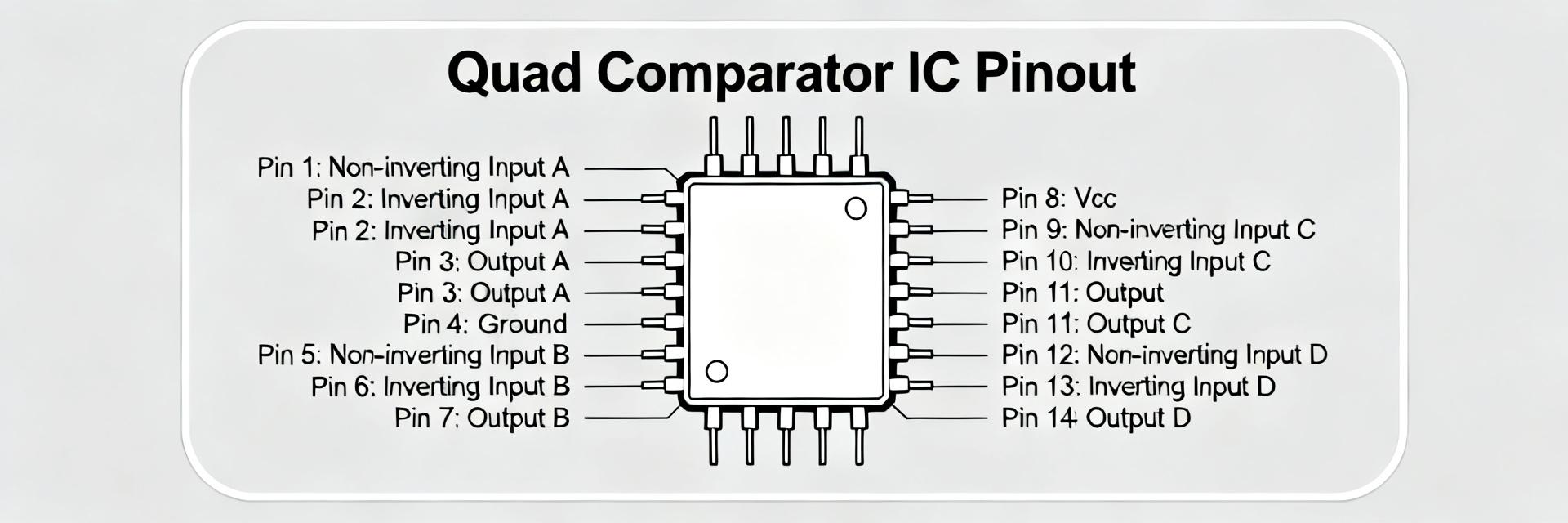
Pinout & Pin Functions Breakdown
| Pin | Name | Function |
|---|---|---|
| 1 | OUT A | Comparator A output |
| 2 | IN A− | Comparator A inverting input |
| 3 | IN A+ | Comparator A non‑inverting input |
| 7 | V− (GND) | Negative supply / ground |
| 14 | V+ | Positive supply |
Electrical Specifications
| Spec | Typical | Unit |
|---|---|---|
| Input offset voltage | ~20 | mV |
| Input bias current | <1 | µA |
| Usable supply range | 0 to 28 | V |
Design & Integration Guide
To reduce noise susceptibility, place a 0.1 µF ceramic decoupler close to the V+ pin. Keep input traces short and shielded. For noisy environments, implementing hysteresis via a feedback resistor is mandatory to prevent output chatter.
Summary
- 4-channel low-offset comparator optimized for ground-sensing applications.
- Supports wide supply range up to 28V with sub-microamp input bias.
- Requires open-collector pull-up resistors for output logic interfacing.